Technology has taken over the world in all the fields, especially in the field of education. The Covid -19 was a classic example of how technology transformed the field of education within a day. Technology offers students convenient access to information, promotes accelerated learning, and provide various opportunities to apply what they’ve learned. Additionally, it allows students to delve into new subjects and enhance their comprehension of challenging concepts, especially in STEM.
What is STEM?
In 2001, the National Science Foundation revamped its efforts to provide students with high quality science and mathematics education nationwide. They recognized a growing need to prepare students for more success in advanced careers, particularly in the field of healthcare and information technology.
That’s when STEM was born!
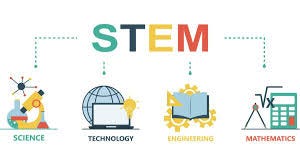
STEM stands for Science, Technology, Engineering and Mathematics. The primary objective of STEM is to prepare students in technical field. STEM, being interdisciplinary focuses on developing various skills in students such as logical reasoning, computational thinking, quantitative analysis and problem solving. These skills are not only essential for individual success but also for national economic growth, as STEM-trained professionals are at the forefront of innovation. STEM education prepares students for careers in fields requiring technical expertise and logical thinking, like software engineering, data science, robotics, and biomedicine.
Despite its strengths, a curriculum that focuses solely on STEM may miss key aspects of a student’s development, such as creativity and adaptability. By emphasizing purely technical skills, there’s a risk of narrowing students’ vision, potentially limiting their creative problem-solving abilities. Thus comes an extra ‘A’ in STEM, transitioning it into STEAM.
What is STEAM?
“It is the mission of all art to express the highest and the most beautiful ideals of man” — Isadora Duncan
You may have wondered about the terms STEM vs. STEAM as they are sometimes used interchangeably, but these two educational approaches actually have different student outcomes and different academic focuses. Here’s what you should know about what that extra letter “A” means. Adding the arts to STEM creates a more well-rounded approach to education. In STEAM, the “A” represents not only traditional arts like music, dance, and visual arts but also design thinking, creativity, and emotional intelligence. It blends scientific rigor with artistic thinking. These elements are crucial in encouraging students to think outside the box and approach problems from various perspectives.
The arts nurture curiosity, imagination, and self-expression, which are all invaluable in a world driven by innovation. For instance, design elements in engineering solutions or creative visualization in data analysis make ideas more accessible and engaging. Arts education fosters a connection to emotions and a better understanding of human experiences. These skills are vital in fields like healthcare and technology, where empathy can lead to more effective, user-centered solutions. STEAM allows students to tackle challenges using both analytical and creative approaches. In real-world scenarios, problems are rarely linear, and blending artistic intuition with scientific precision often leads to breakthroughs.
Conclusion
STEAM prepares students for the future by combining creativity with technology, while STEM provides the deep, specialized knowledge needed to succeed in a technical career. STEAM suggest that by adding the arts, students are better equipped to address the challenges of a rapidly changing world, where creativity and technical expertise often go hand in hand. On the other hand, STEM should be the primary focus, as a deep understanding of science, math, and technology is critical in an increasingly tech-dependent society.
Ultimately, both models are important. The ideal solution might involve blending the strengths of both: a strong foundation in technical knowledge, along with an emphasis on creativity and problem-solving.